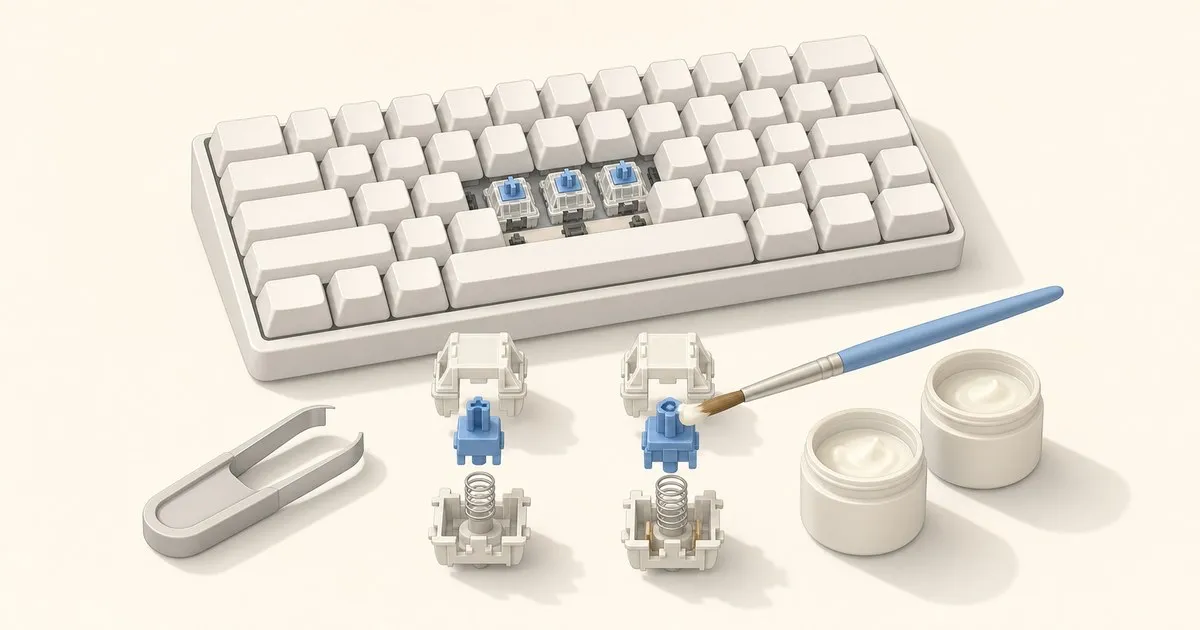
Best Lube for Keyboard Switches: Krytox vs TriboSys
The best lube for keyboard switches depends on grade, not brand: Krytox 205g0 for linears, TriboSys 3203 for tactiles, and 105g0 oil for springs.
Almost every “best lube for keyboard switches” argument is really an argument about one number: viscosity. Krytox and TriboSys are the two names that dominate the conversation, but they are not competitors in the way the question implies. They are ranges of thickness, and the correct pick is decided by what you are lubing (stem, spring, stabilizer wire) and what feel you are trying to protect (a linear glide, or a tactile bump you paid extra for).
This guide is a selection guide, not a technique guide. It compares the products by published grade and manufacturer specification, says which one belongs on which component, and lists the products that look like keyboard lube but will damage a switch. If you already know what to buy and need the application method instead, the step-by-step switch-lubing walkthrough covers brush technique, coverage, and the reassembly order.
The short answer
- Linear switches: Krytox GPL 205g0.
- Tactile switches: TriboSys 3203, or 3204 if you want a slightly fuller feel and accept a slightly softer bump.
- Springs: Krytox GPL 105g0. It is an oil, not a grease, and nothing else on this list substitutes for it.
- Stabilizer wires: a thick dielectric grease. Not switch lube.
- Clicky switches: nothing on the click mechanism, ever.
Everything below is why.
Comparison: the five products that matter
| Product | Form | Relative thickness | Correct use | Do not use on |
|---|---|---|---|---|
| Krytox GPL 205g0 | Grade 0 grease | Thick | Linear stems, housings, rails | Tactile stem legs |
| TriboSys 3204 | Grade 0 grease | Medium | Medium and heavy tactiles, heavy linears | Light tactiles you want crisp |
| TriboSys 3203 | Grade 0 grease | Thin | Tactiles, light springs, silent switches | Housing rails alone (too thin to fill) |
| Krytox GPL 105g0 | Oil | Very thin | Springs only | Stems, housings, stabilizers |
| Dielectric grease | Silicone grease | Very thick | Stabilizer wires and housings | Anything inside a switch |
The naming is the part that trips people up. In the Krytox scheme, the number after the “g” is the NLGI consistency grade, which describes how stiff the grease is at rest. 205g0 and 205g2 are the same base lubricant at two different thicknesses, and only the g0 belongs in a switch. A tub of 205g2 applied to stems produces a switch that feels waterlogged and slow, and undoing it means a full teardown and an isopropyl clean. If a listing does not spell out the grade, treat that as a reason to buy elsewhere.
TriboSys is manufactured by Miller-Stephenson, which also distributes Krytox, so the two families are not rivals from opposing camps — they are neighbouring viscosities from the same shelf. Per the manufacturer’s own product notes and Kinetic Labs’ side-by-side write-up, 3203 is the thinner of the pair and 3204 sits between 3203 and 205g0. That ordering, thin to thick, is the entire decision tree:
105g0 (oil) → 3203 → 3204 → 205g0 → 205g2 (too thick) → dielectric grease (stabilizers only)
Best lube for tactile switches
This is the question that gets asked most and answered worst. The default community answer of “just use 205g0” is wrong for tactiles, and the reason is mechanical rather than aesthetic.
A tactile bump is produced by the stem’s legs riding over a leaf. The sharpness of that bump depends on how abruptly the leg can slip past the leaf. Grease with higher viscosity puts a thicker film in exactly that contact, which rounds the transition. On a strongly tactile switch, such as a Boba U4T or a Durock T1, a heavy coat of 205g0 across the legs is enough to turn a switch you bought for its snap into something closer to a slow linear.
So for tactiles:
- TriboSys 3203 is the safe pick. It is the thinnest grease of the three and it removes scratch from the stem walls and rails while leaving the bump close to stock.
- TriboSys 3204 is defensible on heavier tactiles where the bump has force to spare, and it gives a slightly deeper, fuller sound than 3203.
- Krytox 205g0 is acceptable on the bottom-housing rails of a tactile switch, where it never touches the legs. Many builders use exactly this split: 205g0 on the rails, 3203 on the stem walls, nothing on the legs.
Whichever grease you choose, the legs stay bare. That rule outranks the product choice.
Not sure which family you have? The switch types guide identifies linear, tactile and clicky by feel and force curve, and the Switch Finder by Feel will map a description of the feel you want onto specific named switches with their specs.
Best lube for linear switches
Linears are the forgiving case. There is no bump to protect, so the goal is simply the thickest film the switch can carry without feeling sluggish, and that is what 205g0 was adopted for.
Krytox GPL 205g0 is a PTFE-thickened perfluoropolyether grease. Two properties earn it the default slot: it is chemically inert against the polymers used in switch housings (nylon, POM, polycarbonate), and it does not migrate or dry out over the timescales a keyboard lives on. Applied thinly to stem rails, stem walls and bottom-housing rails, it removes the high-frequency scratch of plastic dragging on plastic and drops the sound profile slightly.
TriboSys 3204 is a reasonable alternative on heavy linears where 205g0 feels like too much, and a genuinely better choice on speed-style linears with shortened travel, where a thick film eats into an already short stroke.
Buy by grade, not by brand name: the two products to look for are Krytox GPL 205g0 and TriboSys 3203. Marketplace listings for both are inconsistent about which grade is actually in the tub, and counterfeit Krytox is common enough that the grade printed on the label is worth checking against the manufacturer’s product page before ordering. Buying from a keyboard specialist that decants from a known lot, rather than from a generic marketplace search, is the safer route.
Springs: the one component with a different product
Spring ping is a metallic ringing that some switches produce on the upstroke. It is a spring resonance, not friction, and greasing it out with 205g0 introduces drag on the return.
Krytox GPL 105g0 is an oil rather than a grease and is the standard answer. It coats the coils, damps the resonance, and adds essentially no resistance. It also spreads on contact, which is why the bag method works: a sandwich bag, the springs, two or three drops, thirty seconds of shaking, then let them drain on a paper towel. A single small bottle covers many boards because the per-spring volume is tiny.
If you own 3203 and no 105g0, 3203 on springs is a workable substitute in a pinch. The reverse is not true — 105g0 on stems is far too thin to fill surface imperfections and will do very little.
Stabilizers use a different product entirely
The most common misdiagnosis in the hobby is treating a rattly spacebar as a switch problem. It is a stabilizer problem, it has its own product, and switch lube is the wrong tool.
Stabilizer wires want a thick dielectric or white-lithium-style grease, because here the viscosity is the fix: the grease damps the wire’s movement inside the housing rather than merely reducing friction. Using 205g0 on a stabilizer wire is not harmful, but it is too thin to silence rattle, and you will conclude the mod does not work. The stabilizer tuning guide covers clipping, band-aid mods, and wire lubing, and it is the higher-value job of the two if your board currently rattles.
Silent and magnetic switches
Silent switches have rubber dampeners moulded into the stem. Grease can swell or soften some elastomers over time, so keep lube off the dampener pads and use the thinner grease (3203) on the walls and rails. The dampener is doing the sound work; you only need to remove scratch.
Magnetic (Hall effect) switches are the newer question, and the answer is a qualified yes. They are still a stem sliding inside a housing, so the friction surfaces lube the same way, and a light coat of 3203 on the rails and walls is normal practice. Two cautions: keep grease entirely away from the magnet seat and the sensor face at the bottom of the housing, and check the manufacturer’s guidance first, because some magnetic boards calibrate per-switch travel and any change that alters seating can require a recalibration pass. Many magnetic switches also ship factory-lubed, which makes the whole exercise optional. If you are weighing a magnetic board in the first place, Hall effect switches vs mechanical covers what the technology buys and what it costs.
What not to use
Everything in this list appears in forum advice somewhere, and all of it causes damage:
- WD-40 and similar penetrating sprays. A solvent carrier, not a lubricant. It attacks plastics and evaporates, leaving a residue.
- Silicone spray. Uncontrollable coverage, and it will reach the metal leaf and cause contact issues.
- Petroleum jelly. Too thick, softens with hand heat, migrates into the contact area.
- 3-in-1 or sewing machine oil. Mineral oils are not chemically inert against every switch polymer and can craze housings over time.
- Any grease with visible particulate. Lithium greases with solid additives will feel gritty, which is the exact opposite of the goal.
- Krytox 205g2. The right chemistry at the wrong grade, and the single most common expensive mistake.
How much you actually need
A 5 g syringe or tub of 205g0 covers roughly two to three full-size boards at correct coverage, and considerably more if your coats are as thin as they should be. A 5 mL bottle of 105g0 covers many boards’ worth of springs. The practical implication is that lube is not the expensive part of this project — your time is. Buy the small size, and buy the grade that suits your switches rather than a large tub of the wrong one.
You also need a switch opener and a fine brush. A size 00 round brush is the usual recommendation, and a purpose-made opener matched to your switch mount (MX-style and Kailh-style openers are not interchangeable) rather than a flathead screwdriver, which snaps housing clips.
Do you need to lube at all?
Often, no. Factory pre-lubed switches from established makers are good, and the gap between a decent factory job and a careful hand job is real but modest. Buy dry switches if you want the project; buy pre-lubed if you want the keyboard.
The honest ranking of sound-and-feel upgrades by return on effort puts hand-lubing third. Tuned stabilizers come first, good keycaps second, and case foam and sound mods sit alongside lube. If your board sounds wrong today, work that list in order rather than starting with the most time-expensive item.
Related reading
- How to lube mechanical keyboard switches — the application method for everything chosen here
- Linear vs tactile vs clicky switches — identify what you have before you pick a grade
- Keyboard stabilizers explained — the different product, and the higher-value job
- How to find your switch preference — confirm a switch is worth hours of work first
- Keyboard sound mods: foam, tape, and thock — the other levers on sound
Sources
Related

How to Lube Mechanical Keyboard Switches (and Not Ruin Them)
A step-by-step guide to lubing linear and tactile switches: which lube to use, how much to apply, and the mistakes that ruin a whole set of switches.

How to Choose Your First Mechanical Keyboard the Smart Way
A framework for buying your first mechanical keyboard: the four decisions that matter, why hot-swap is non-negotiable, and which upgrades pay off.

How to Find Your Switch Preference With a Switch Tester
A practical method for finding the mechanical switch you actually like: how to use a switch tester properly, and why first impressions mislead.