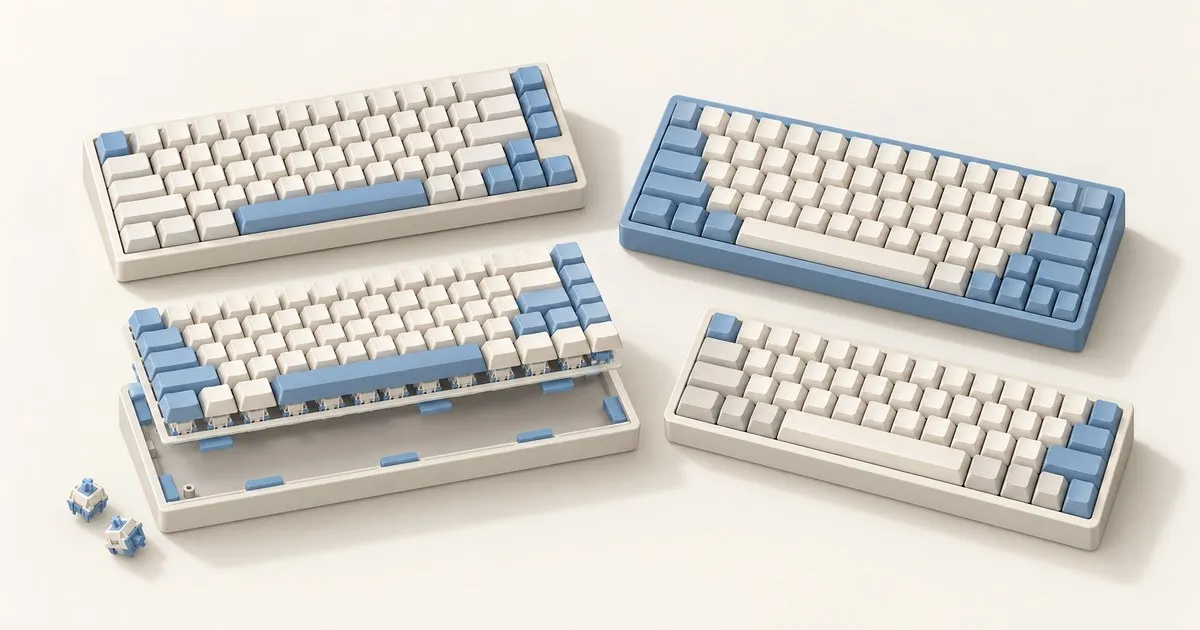
Gasket mount is the most abused spec label in the budget market, so shopping for the best gasket mount keyboard under 100 dollars means reading spec tables instead of product headlines. Two of the most-recommended candidates do not qualify: retailer spec sheets list the $84 wired Keychron V1 as a plate mount with a steel plate, and the $89 V6 the same way, yet both turn up in gasket-mount filters on price-tracking sites. Four boards at this price do suspend the plate, and they differ more than the price spread suggests.
The short list
Prices are what these listings showed in September 2026. Budget boards move, and aggregator “lowest price” figures often point at an ISO or odd-colorway SKU.
| Board | Listed price | Layout | Case / plate | Mount | Wireless | Firmware |
|---|---|---|---|---|---|---|
| Akko 5075B Plus | $85.99 | 75%, 83 keys | plastic / polycarbonate | gasket mount structure | BT + 2.4 GHz + USB-C | Akko driver, VIA not listed |
| MonsGeek M1 kit | $60 clearance, $120 list | 75% | CNC aluminum / polycarbonate | gasket | none | QMK and VIA |
| Keychron V1 Max, barebone | ~$94 tracked, $110 assembled | 75% | ABS / polycarbonate | gasket | BT 5.1 + 2.4 GHz + USB-C | QMK and VIA |
| Keychron Q3, ISO clearance | $59 ISO tracked, $135 ANSI | TKL | 6063 aluminum / steel | plate mount, double gasket | none | QMK and VIA |
Route yourself in three questions. Assembling it or not? If not, the Akko 5075B Plus is the only pick that arrives finished: switches, ASA doubleshot PBT caps, 3000 mAh battery, tri-mode wireless, $85.99. Wireless? That removes the MonsGeek and the Q3, both wired only. QMK or VIA? That removes the Akko, whose listing specifies the Akko Cloud Driver and never claims VIA.
If a kit is acceptable, the MonsGeek M1 is the one board here with a CNC aluminum case: gasket mounted, polycarbonate plate, screw-in stabilizers in the box but not preinstalled, a 1.2 mm hot-swap PCB, plate and case foam plus an IXPE switch pad, and 1.96 kg of mass, listed at $60 on clearance against a $120 list. Cheapest honest route to an aluminum gasket board, with the barebone caveat below.
The Keychron V1 Max is the wireless-plus-firmware answer: ABS case, polycarbonate plate, gasket mount, screw-in stabilizers, 1000 Hz polling wired and in 2.4 GHz mode, a 4000 mAh cell, QMK and VIA. Only the barebone lands under $100; assembled it was $110, down from $114.99.
What counts as gasket mount at this price
A gasket mount holds the plate between the case halves on compressible strips, usually silicone or poron, instead of screwing it to either half. The Q3 is described as a plate mount with a double-gasket mechanism, which is the honest phrasing: pads sit above and below the plate tabs. A plate mount fastens the plate to the case; a tray mount screws the PCB to standoffs in the bottom shell. The structural comparison matters more than the marketing word.
Two tells separate a real gasket board from a marketing one:
- A foam stack is not a mount. IXPE switch pads, plate foam and case foam shape sound, and every board above ships some, but they suspend nothing. The foam and sound mods guide covers what each layer changes.
- Check the case and plate separately. The cited listings specify polycarbonate plates for the V1 Max and M1, with ABS and aluminum cases respectively. Those construction details do not establish a sound ranking.
Compare construction before choosing switches
Use the documented case, plate, and mounting specifications to compare these boards:
| Board and cited listing | Case | Plate and mount | Assembly detail |
|---|---|---|---|
| Keychron V1 Max | ABS | Polycarbonate, gasket mount | Barebones and assembled versions; screw-in stabilizers listed |
| MonsGeek M1 kit | CNC aluminum | Polycarbonate, gasket mount | 1.2 mm hot-swap PCB; included screw-in stabilizers require installation |
| Akko 5075B Plus | Plastic | Polycarbonate, gasket mount structure | Assembled with switches and ASA doubleshot PBT keycaps |
Gasket mounting describes how the plate is supported; switch compatibility is a separate PCB specification. Before buying replacement switches, match their footprint to the exact board’s socket requirements. A hot-swap label alone does not identify the compatible switch family or pin layout.
These listings do not provide a controlled comparison of the same switches across cases and key positions. They cannot support row-by-row sound predictions or a ranking of which board produces the deepest note. Keep the switch choice separate from those unmeasured claims: test before you buy, and consult the lube selection guide if you decide to lubricate dry switches before assembly.
Watch-outs
- Spec sheet over marketing bullet. Retailers list the wired V1 and the V6 as plate mounts with steel plates. Decent boards, wrong list.
- Barebone math. A $94 V1 Max barebone plus switches and keycaps is a $140 to $170 board. If under $100 is the hard constraint, buy prebuilt.
- Stabilizer state. Screw-in stabilizers are listed on the V1 Max, M1 and Q3, but screw-in does not mean tuned, and the M1’s are not preinstalled. Budget an hour for stabilizer work or accept rattle on space and shift.
- Firmware lock. VIA needs a definition to exist for your board; the project advertises 1400-plus keyboards and says others can be added to QMK keyboards. A vendor driver like Akko’s is a different thing, and QMK’s docs are the path if you want to build firmware yourself. The remapping walkthrough shows what that buys you.
- Keycap profile. Akko ships ASA, Keychron ships OSA. Both are vendor profiles, so a Cherry or OEM set will change row heights noticeably.
- Clearance SKUs. The $59 Q3 figure is an ISO-layout collection. On ANSI, expect closer to the $135 listing.
Compared to the tiers either side
Roughly $40 below, the Epomaker x Aula F75 starts around $49 wired and is listed as gasket mount in a plastic case, with tri-mode variants higher in the line. The remapping story is unclear on the listings, so treat it as a sound-first board you will not reprogram. It wins for anyone who wants plate flex and a dampened stack and does not care about layers.
Roughly $40 above, the assembled V1 Max at $110 and the ANSI Q3 at $135 remove the compromises: aluminum or a finished wireless build, QMK and VIA, screw-in stabilizers, factory-tuned foam. That tier is worth the difference if you want one purchase to be finished. If the mount is the point and you expect to open the board anyway, the $60 to $86 picks are where the value sits, and the broader under-$100 field has strong non-gasket options if flex turns out not to be your priority.
Related across the network
- Best Mechanical Keyboards Under $100 in 2026: 4 Picks — keyboardranker.com


